
Safeguarding
Our academy works with parents and carers to make sure that every pupil can achieve excellence in all that they do.
📢 If you have an immediate concern about the safety of a child, or you believe that a child is in danger, you should contact the emergency services. 📢


Our Safeguarding Staff
We are committed to safeguarding and promoting the welfare of children and young people. We have a specialist team of staff who lead safeguarding in our academy.
Mrs. Colleran: Academy Designated Safeguarding Lead, Assistant Vice Principal Safeguarding & Attendance
Miss Grogan: Academy Deputy Designated Safeguarding Lead
Miss Marshall: Academy Deputy Designated Safeguarding Lead
Miss Morrison: Academy Deputy Designated Safeguarding Lead
Ms. Smedley: Safeguarding Officer
What is Safeguarding?
Safeguarding is the action taken to promote the welfare of children and protect them from harm.
Safeguarding means:
- Protecting children from abuse and maltreatment;
- Preventing harm to children’s health or development;
- Ensuring children grow up with the provision of safe and effective care;
- Taking action to enable all children and young people to have the best outcomes.
You can find our Child Friendly Safeguarding Policy by clicking the button below:
Reporting a Concern
If you are concerned about a pupil in our academy, however small it may seem, you can report this by:
noma-concern@coopacademies.co.uk.
This can include concerns over a change in appearance (including weight), attitude/behaviour, as well as concerns raised by the child themselves or by others.
All safeguarding concerns are looked into, and relevant actions are taken.
Our Safeguarding Team
If you are upset or concerned about yourself or someone you know, there are lots of ways to help:
You can speak with any adult in the academy who will pass your concern to the safeguarding team.
You can write your concern on a piece of paper and post it in the safeguarding box in the Yellow Winter Garden.
You can email your concern to:
Operation Encompass
Our school is proud to be part of Operation Encompass, a national police and education early intervention partnership that supports children experiencing domestic abuse.
Through this partnership, the police share information with our school's Key Adult regarding police-attended domestic incidents involving children in our school, ensuring notifications arrive before the start of the next school day.
This allows us to provide immediate, targeted support to our pupils, ensuring they are helped to feel safe, understood, and ready to learn.
Prevent Statement
The Prevent lead is Lauren Colleran.
This Statement is to be read in conjunction with:
- The Academy Safeguarding and Child Protection Policy, Prevent duty guidance: for England and Wales (accessible) - GOV.UK (www.gov.uk)
- Keeping Children Safe in Education
Introduction to the Prevent Strategy
Everyone who comes into contact with children, young people and their families has a role to play in safeguarding. Schools and colleges have a duty of care to their pupils and staff which includes safeguarding them from the risk of being drawn into terrorism. This includes not just violent extremism but also non-violent extremism, which can create an atmosphere conducive to terrorism and can popularise views which terrorists exploit. Schools and colleges should be safe spaces in which children and young people can understand and discuss sensitive topics, including terrorism and the extremist ideas that are part of the terrorist ideology and learn how to challenge these ideas.
The aim of Prevent is to stop people from becoming terrorists or supporting terrorism. Prevent also extends to supporting the rehabilitation and disengagement of those already involved in terrorism.
The objectives of Prevent are to:
- tackle the ideological causes of terrorism;
- intervene early to support people susceptible to radicalisation;
- enable people who have already engaged in terrorism to disengage and rehabilitate.
Definitions
From Keeping Children Safe in Education
Extremism is the vocal or active opposition to our fundamental British values, including democracy, the rule of law, individual liberty, and mutual respect and tolerance of those with different faiths and beliefs.
Radicalisation is the process of a person legitimising support for, or use of, terrorist violence.
Terrorism is an action that endangers or causes serious violence to a person/people; causes serious damage to property; or seriously interferes or disrupts an electronic system. The use or threat must be designed to influence the government or to intimidate the public and is made for the purpose of advancing a political, religious or ideological cause.
Preventing Radicalisation in School and College
Building resilience in our young people and the promotion of fundamental British values is at the heart of preventing radicalisation. We do this by providing a safe place in which children and young people can discuss issues, and we aim to give them the knowledge and confidence to challenge extremist beliefs and ideologies.
The Prevent duty is carried out under the Counter-Terrorism and Security Act 2015, which legally requires us to take steps to prevent pupils from being drawn into terrorism. We take this duty seriously and carry out the main actions responsibly, namely: understanding risk, managing risk, sharing information, reducing permissive environments, monitoring and assurance.
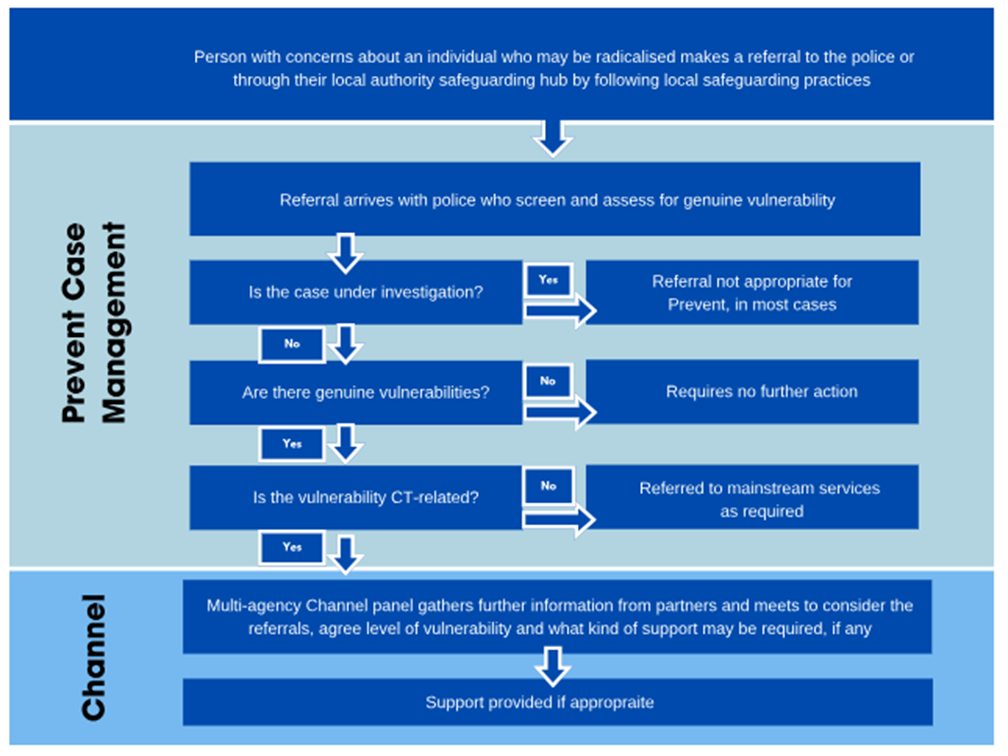
If we assess a child as at risk, we will refer to the Channel Programme, which focusses on providing support at an early stage to people who are identified as being vulnerable to being drawn into terrorism.
We recognise that we play a vital role in keeping children and young people safe from harm, including from the risks of extremism and radicalisation, and in promoting the welfare of children in our care.
What We Do if There is a Concern
If we have a concern about a particular pupil we will follow the school’s normal safeguarding procedures, including discussing with the school’s designated safeguarding lead or member of staff with designated responsibility for Prevent, and where deemed necessary, with children’s social care.
We may also contact the local police force or dial 101 (the non-emergency number). They can talk to us in confidence about concerns and help us gain access to support and advice. In an emergency situation, we will follow the recommended emergency procedures.
Making a referral to Prevent - GOV.UK (www.gov.uk)
Visitors to the Academy
Sometimes we have visitors in the academy who speak to our pupils. All external visitors who meet with pupils must have a current, enhanced DBS certificate. External agencies will be asked to provide the academy with the name of the person(s), together with their DBS certificate number and issue date before meeting with pupils. No visitor will be allowed to meet with a pupil alone unless we have verification of documentation.
All visitors to the academy will be asked to sign in and out.
They will all be provided with a copy of the academy Safeguarding leaflet.
Accessing Help and Support
During term time, we are on hand to offer pupils and their families a high level of support. If you need to seek advice about your child, you should contact their Form Tutor or Pastoral Manager in the first instance. They will then advise on what to do next and may refer the matter to someone else.
Further details are outlined in our Safeguarding leaflet.
If you are struggling or worried about a young person, support remains available elsewhere:
During evenings, weekends and holiday times, anyone with concerns should contact the organisations below:
NHS
📞 Telephone
111 for urgent mental health support.
999 in an emergency, or go to A&E.
NSPCC
🌐 Web
Childline
🌐 Web
📞 Telephone
0800 1111
Samaritans
📞 Telephone
116 123 (free, 24/7)
Manchester Social Services
🌐 Web
📞 Telephone
0161 234 5001
If you have any worries about a child’s safety or welfare, you should speak to a Contact Officer at the Manchester Contact Centre.
📞 Telephone
0161 234 5001
📠 Fax
0161 255 8266
Shout
Text SHOUT to 85258 (free 24/7)
The Contact Officer will then notify the First Response Team of your concerns.
There is a wide range of support available for children when they are not in school too.
You can find them on our helplines page here.
Parent Resources